Seeing an error code on your Vaillant heat pump can be a bit worrying.
But before you start thinking about expensive repairs, don’t panic. An error code doesn’t necessarily mean there’s a major fault with your heat pump. Sometimes it’s something fairly straightforward, while other faults will need an engineer to take a closer look.
If you’ve got a Vaillant aroTHERM or aroTHERM plus and you’ve got an F.22, F.532, F.539 or another code showing on the display, here’s what it means, what you can check yourself and when it’s time to get an engineer involved.
First things first: make a note of the error code
Before doing anything, make a note of exactly what the heat pump is displaying.
You might be able to clear a temporary fault by resetting the system, and Vaillant says that resetting the heat pump can sometimes get it working again.
But there’s an important difference between clearing a fault and fixing the reason it happened.
If the same error keeps coming back, don’t just keep resetting the heat pump and hoping it’ll disappear. The recurring fault needs to be investigated.
F.22: Low water pressure
An F.22 error means the water pressure in the heating system is too low.
Your heating system needs enough water pressure to circulate water properly around the system. Vaillant gives a normal system pressure of around 1 to 1.5 bar.
There are a few things that can cause the pressure to drop, including:
- A leak somewhere in the heating system
- Air in the heating circuit
- A problem with the pressure sensor
- A faulty expansion vessel
If you’re comfortable doing so, you can check the pressure shown on your system.
If it’s below 1 bar, the system may need topping up using the filling loop. You should increase the pressure slowly and avoid overfilling the system.
If the pressure is already above 1 bar and you’re still seeing an F.22 fault, or the pressure keeps dropping after you’ve topped it up, get an engineer to investigate.
Repeatedly topping up the system isn’t a fix if there’s an underlying problem causing the pressure to fall.
F.532: Building circuit flow rate too low
An F.532 means your Vaillant has detected that the water flow through the building heating circuit is too low.
In simple terms, your heat pump isn’t getting enough water moving around the heating system.
There are a few things that can cause this, including:
- A blocked or restricted filter or Y-strainer
- A restriction somewhere in the heating circuit
- Air or debris in the system
- The heating system not being correctly balanced
- A bypass being incorrectly adjusted
- Insufficient water flow
- Low system pressure
This is an important one because poor flow can affect how well the heat pump transfers heat into your home.
If you’re comfortable doing so, check the system pressure and have a look for anything obvious, such as a leak.
But don’t start taking the heat pump apart or adjusting valves and settings unless you know exactly what you’re doing.
If the F.532 keeps coming back, you’ll need an engineer to check the heating circuit and find out why the flow rate is too low.
F.733: Evaporation temperature too low
An F.733 error means the evaporation temperature has dropped too low.
In simple terms, this can happen when the outdoor unit isn’t getting the airflow it needs, or when there’s an issue within the refrigerant circuit.
One thing that can contribute is dirt or debris restricting the outdoor heat exchanger.
There can also be other causes, including:
- A problem with the compressor inlet temperature sensor
- An expansion valve fault
- Low refrigerant levels
- Dirt or debris restricting the outdoor heat exchanger
This is one where you can start with a visual check.
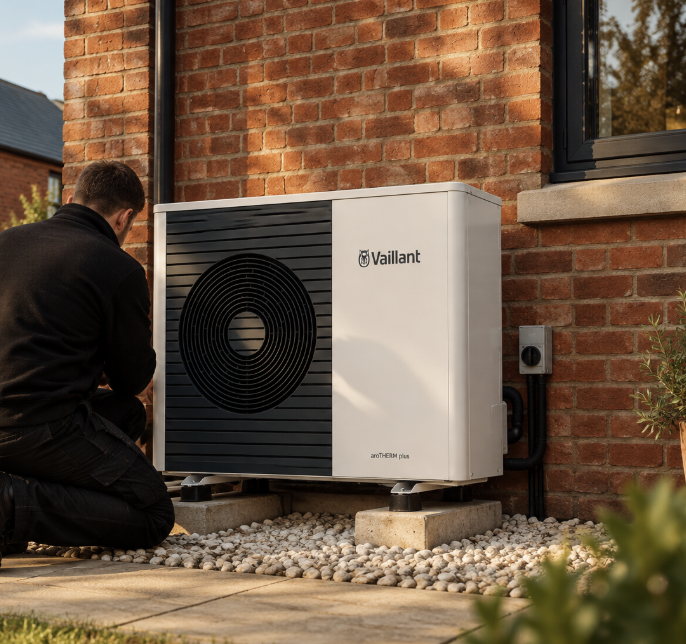
Have a look at the outdoor unit and make sure the air intake and heat exchanger aren’t obviously blocked by leaves, dirt or other debris.
Don’t start dismantling the outdoor unit to clean components internally.
F.731: Refrigerant high-pressure switch open
An F.731 error means the high-pressure switch in the refrigerant circuit has opened.
That sounds complicated, but there can be a connection between this type of fault and what’s happening on the heating side of the system.
Poor water flow is particularly worth mentioning here.
If the heat pump can’t move heat effectively into the heating system, this can affect the way the refrigerant circuit operates.
If an F.731 disappears after a reset but then returns once the heat pump has been running for a while, your heating system may need to be checked for issues such as restricted flow, air or a blocked filter.
If the fault comes straight back after a reset, or keeps returning, get an engineer to investigate rather than repeatedly resetting the heat pump.
F.788: Building circuit pump fault
An F.788 means there’s a fault with the building circuit pump.
The building circuit pump is responsible for moving heating water around your property. If there’s a problem with the pump, your heat pump may not be able to move enough heat around the heating system.
Possible causes include:
- An electrical connection problem
- A wiring fault
- A faulty circulation pump
- Air in the heating circuit
- A blocked or restricted filter or Y-strainer
There’s not much you should try to fix yourself here.
You can check the basics, such as whether there’s an obvious leak or whether the system pressure looks unusually low.
But if you’re seeing F.788, the heating system and circulation pump need to be checked properly.
Your installer or a qualified engineer can check the flow rate, pump operation and heating circuit to find the cause of the fault.
Need your heat pump serviced?
Choose a one-off heat pump service or join our Annual Heat Pump Service Plan and we’ll take care of it each year.