Why do heat pump settings matter?
Air source heat pumps run a bit differently from traditional gas boilers. They generally work best when they’re run steadily and efficiently rather than constantly being switched on and off.
A few small changes to your settings can make a surprisingly big difference.
This is the guide to reducing your bills but still keeping your home warm.
1. Set your room temperature
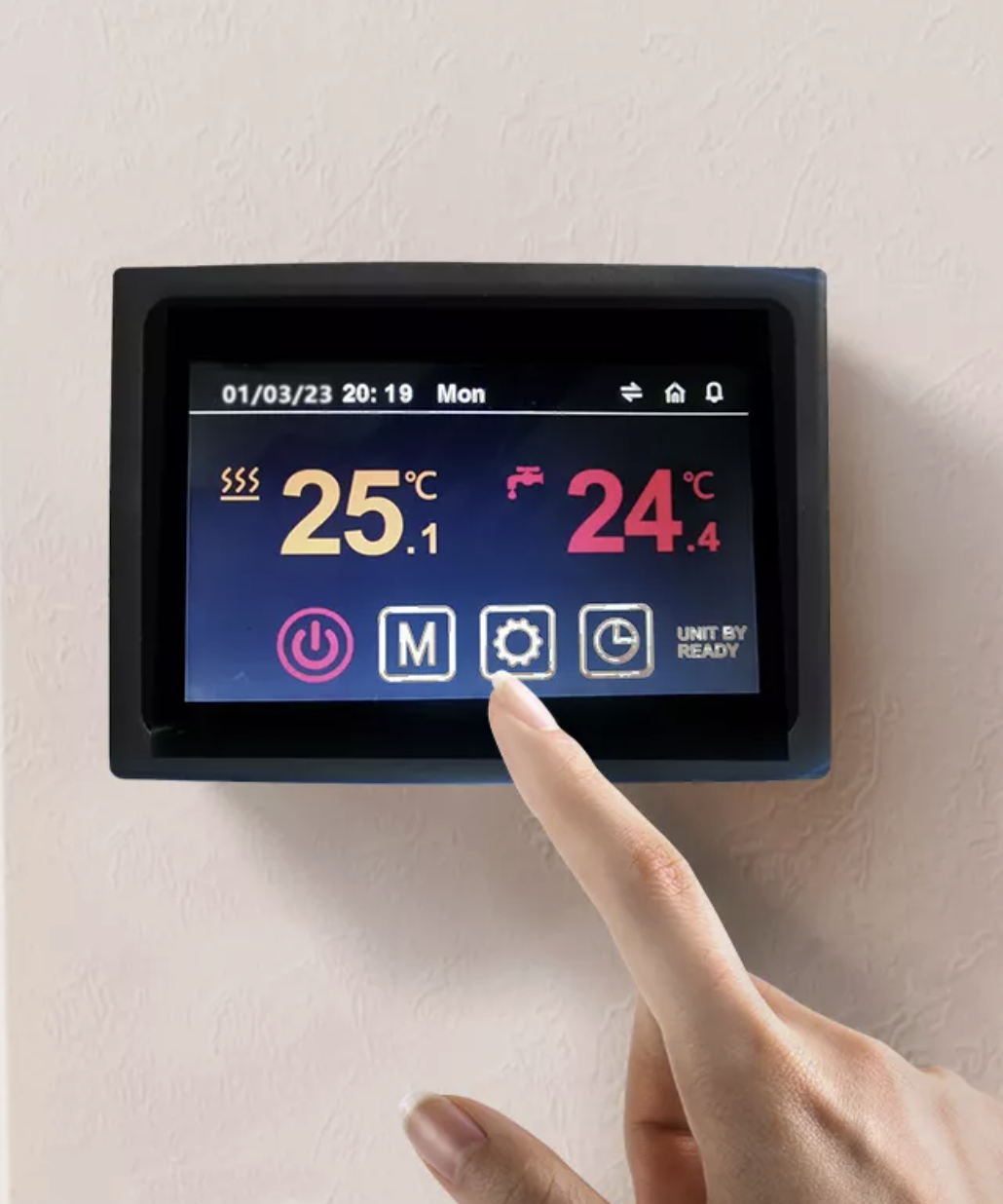
A good place to start is to set your room temperature to somewhere around 18-21 degrees. Test this and see which temperature feels comfortable for you, you can then adjust this if needed.
The most important part of reducing costs is to not set the temperature higher than you actually need it. As the higher the temperature you’re asking your system to maintain, the more work it generally has to do.
The best setting is one that keeps you comfortable without unnecessarily overworking the system.
2. Keep heating steady for longer periods
An air source heat pump produces heat at a lower temperature and is designed to gently maintain a comfortable temperature in your home. Keeping the heating running for longer periods allows the system to work efficiently, without constantly having to catch up from a colder starting point.
Instead of turning your heating off completely and then turning it up high when you feel cold, try setting your thermostat to a comfortable temperature and letting your heat pump maintain it. You may find that a small temperature adjustment works better than large changes throughout the day.
This steady approach can help your heat pump run more efficiently, reduce unnecessary energy use and keep your home feeling more comfortable.
3. Check your flow temperature
Your flow temperature is the temperature of the water being sent from your system. Getting this setting right can make a big difference to how efficiently your air source heat pump runs.
Generally, the lower you can set the flow temperature while still keeping your home comfortably warm, the better it will operate. Look at how your home feels, not just the number on the display. If your rooms are reaching and maintaining comfortable temperatures, your flow temperature is doing its job. Your radiators may feel warm rather than extremely hot, which is completely normal with a heat pump.
If your home is taking a very long time to reach the target temperature, or becoming noticeably cooler than you’d like, your flow temperature may be set too low.
If this happens, make small adjustments to the temperature and give it time for your system to adjust (several hours to a day). If you’re constantly increasing the flow temperature but your home still isn’t heating properly, we would then recommend having the system checked by our qualified heat pump engineer.
4. Use your heating schedule
Using your heating schedule well can help you stay comfortable without heating your home unnecessarily. The schedule is a way of slightly adjusting the temperature around your routine.
Use the schedule to start your heating before you need it, as it warms your home gradually. If you change your settings, give the schedule time to work and monitor how this feels over the next few days.
If you’re out during the day or asleep at night, lowering the temperature slightly rather than switching the heating off completely can help your heat pump work more efficiently when you need it again.
5. Check your weather compensation
Weather compensation is one of the most important settings for helping your heat pump run efficiently.
Your system can respond to changing weather conditions without you constantly needing to adjust the settings yourself.
The easiest way to check if this is working well is to look for patterns. If you’re always too cold on colder days and too warm during milder weather, your weather compensation settings may need fine-tuning. Once it has been properly adjusted for your home, the system can respond to changes in outdoor temperature while maintaining a steady indoor environment.
6. Don’t forget about your hot water
The settings you choose for your hot water cylinder can have an impact on how efficiently the system runs.
Setting a hot water schedule around your household routine can help avoid heating water when you don’t need it. If you usually shower in the morning and evening, you can schedule this to heat the water beforehand, so there’s no need to repeatedly heat this through the day.
A hot water boost can be useful if you’ve unexpectedly used more hot water than usual, rather than having to change your normal schedule.
Don’t turn your hot water temperature or sterilisation settings down too far just to save energy. Your system may have a regular sterilisation cycle designed to control the risk of Legionella bacteria. Keep this enabled and follow your manufacturer’s or installer’s recommended settings.
7. Don’t assume the cost is a settings problem
If your energy bills are higher than expected, it can be tempting to start changing every setting on your heat pump. But the cost isn’t always down to the controls.
Checking your insulation is important. If it is poor, it can mean your home loses heat quickly, making your system work harder. Also, check that all radiators or underfloor heating are working in each room.
Before making lots of changes, look at your energy use over a longer period and consider whether anything else has changed. If your heat pump is running for unusually long periods, your home isn’t reaching the temperature you’ve set, or your electricity use seems unexpectedly high, it could be worth getting the system checked rather than simply turning settings up or down.
8. Don’t rely on boost systems all the time
Most air source heat pumps have a boost or override function that lets you temporarily increase heating or hot water when you need it. It can be useful, but it shouldn’t become part of your everyday routine.
Using boost occasionally is best when you need more hot water than usual, for example when you have guests staying or you’ve used more hot water than usual. Don’t use boost to compensate for poor settings. If you’re constantly reaching for boost, your normal schedule or settings may need reviewing. If you still need boost constantly, this could indicate your system isn’t meeting your home’s heating or hot water demand, and it is worth speaking with one of our engineers.
Need your heat pump serviced?
Choose a one-off heat pump service or join our Annual Heat Pump Service Plan and we’ll take care of it each year.
Book your next heat pump service from just £90.